
There is a moment in cross-border sales where your customer meets your Maths. It’s the moment your shopper looks at the price in the checkout and decides whether to click Buy. That moment is shaped not just by your product, your brand or your delivery promise – but also by something more subtle and far more expensive when it goes wrong: the correct VAT rate.
Most shoppers never think about VAT. Many sellers don’t either, until they realise their platform has been “playing it safe” by assuming Standard Rate VAT for every product in every basket. That might feel sensible (because it means you never undercalculate tax… and who wants to do that, right?) but for many merchants it is the accounting equivalent of carrying a life jacket for a trip through the desert.
Not all products are created equal. Not all VAT rates are either.
Most products attract Standard Rate VAT, yes. But a surprising number don’t.
Most Merchants sell mostly Standard Rate products, for sure. But many Merchants sell at least some reduced rate goods and some Merchants sell nothing but reduced rate goods.
These are just some of the categories in which Products regularly attract zero VAT or reduced VAT:
- Medical equipment
- Safety equipment
- Books, manuals and printed learning materials
- Children’s clothing
- Medicines and pharmaceuticals
- Many food & drink items
- Baby products
- Animal feed
- And many more
These categories aren’t niche or exotic. They represent tens of millions of sales every year. However, many platforms, plugins and marketplaces don’t know how to identify the correct VAT rates automatically… so they default everything to Standard Rate. And Standard Rate is the highest VAT rate in the Customer’s country.
Mixed baskets make the problem bigger
Shoppers don’t always buy in neat, regulation-friendly patterns. They buy a book and a toy for a child’s birthday. Or a first-aid kit and a warning triangle for the car. Or protein powder and pet food.
Each category can have a different VAT rate but many sellers, storefronts and SaaS platforms can’t identify the right rate per product so they choose the one thing they can identify – Standard Rate is an easy lookup table.
It feels “safe”. It is anything but, because when VAT is wrong, it isn’t wrong by a little. It is wrong at every level of the calculation.
Consider a product that should be zero-rated, like a medical item. If your platform assumes a 20 percent Standard VAT rate, here is what happens:
- Your product VAT jumps from €0 to €100 (on a €500 item).
- Your basket suddenly becomes more expensive than competitors.
- Your customer buys elsewhere and you never even know they visited.
But the pain doesn’t stop there. Once the item passes the VAT stage, we land in the world of Customs Duty. Many consignments attract Customs Duty on import (and this will be extended to all incoming consignments by the end of 2026). Customs Duty rates are specific to each Product and they are completely unrelated to the VAT rate of the product.
A book might attract zero duty while a textile item might attract 6 percent. A medical device might attract 0 percent while a sports accessory sits at 8 percent. The Duty Amount is basically the Product price (without Tax) multiplied by the Duty Rate.
And then comes VAT on Duty (yes, tax on tax)
Even after the Customs Duty amount is calculated correctly, there’s a second layer that most merchants forget until it bites them: VAT is charged on the Customs Duty amount.
So when a platform assumes Standard Rate VAT, two things happen:
- VAT on the product is too high.
- VAT on the Duty is also too high.
The mistake compounds. Wrong VAT rate chosen = wrong VAT amount on the Product but also = wrong VAT amount on Duty too. And it is always ‘wrong’ by being higher than it needs to be, never lower.
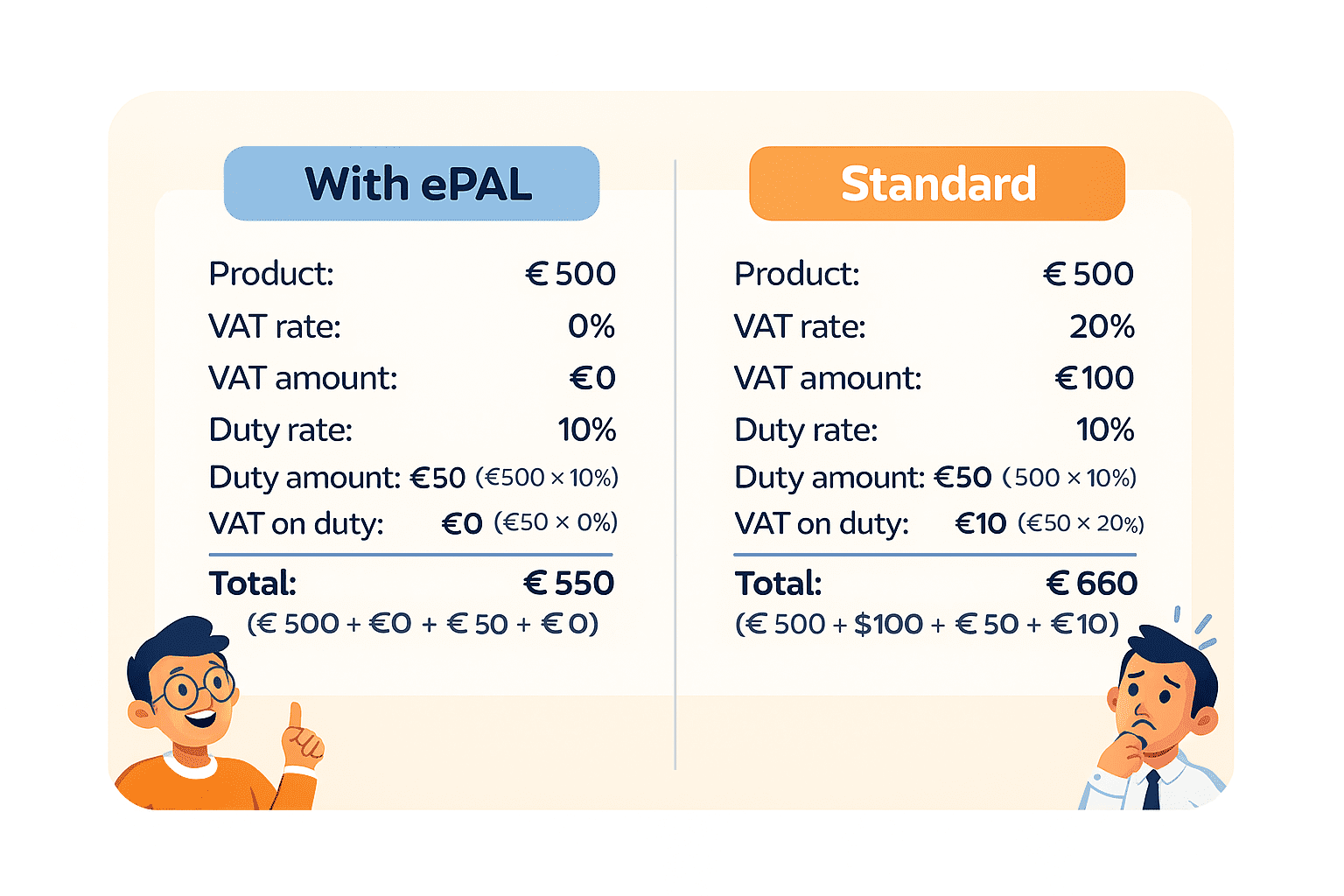
Take our earlier example and assume the product has 10% Customs Duty:
- Product: €500
- Correct VAT rate: 0%
- Duty: €50
- VAT on Duty at correct rate: €0
Total correct cost: €550
But if your platform just assumes Standard VAT (in this case 20%, which is about average across EU countries):
- Product: €500
- Assumed VAT rate: 20%
- VAT on product: €100
- Duty (at 10%): €50
- VAT on Duty (at the same assumed 20%): €10
Total wrong cost: €660
That is a €110 difference created entirely by incorrect identification of the VAT rate. Not by the law. Not by the carrier. Not by Customs. By the platform thinking it was being “cautious”.

Your customer doesn’t care about VAT logic. They care about price.
A shopper comparing two websites does not think:
“Ah yes, Website A has mis-applied Standard Rate VAT to a zero-rated product and compounded the error through the wrong VAT on Customs Duty”
They think:
“Why is this one €110 more expensive?”
Click. They buy where the price is right instead.
And the worst part? They think the difference is you. Not your tax engine, not your plugin, not your platform. You.
The brand takes the blame. The margin takes the hit. The customer takes their business elsewhere – maybe forever.
This is exactly the kind of invisible friction ePAL removes
ePAL identifies the correct VAT rate per product, in real time, using classification logic that understands product categories, destination country rules and mixed-basket apportionment.
It calculates:
- the correct VAT per item
- the correct Customs Duty
- the correct VAT on Duty
- the correct total cost
All before your customer clicks Buy.
No guessing. No overcharging. No buffer margins to “stay safe”. When your price is accurate, your customer trusts it. When your VAT is correct, your basket is competitive. When your landed cost is precise, your brand wins.
This is what ePAL was built for: cross-border compliance with a click.
Visit www.ePALGlobal.com for more info
[…] This is not a new concept. We have seen the same dynamic before in a different context, as discussed here:https://epalglobal.eu/blog/2025/11/27/not-all-products-are-created-equal/ […]