Posted on Leave a comment

Let one-click Fully Landed Cost calculation open the doors to EU sales.

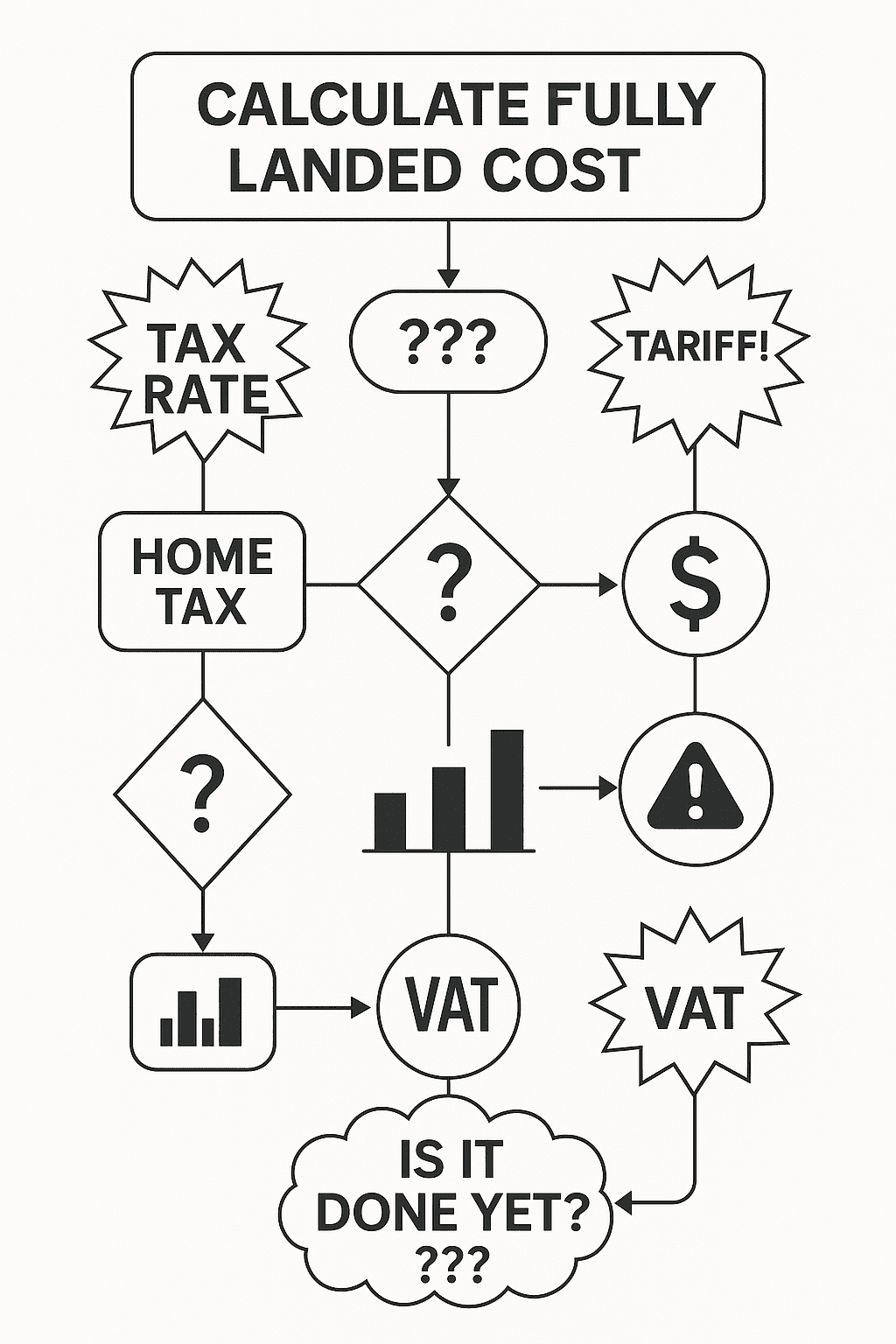
Fully Landed Cost joke flowchart

Ask any merchant what’s stopping them from selling more into the EU, and you’ll rarely hear “lack of customers.” Europe’s 450 million consumers are eager buyers. They love variety, quality and cross-border discovery. The real problem isn’t the demand — it’s the detail.

Behind every potential sale lies a tangle of regulations, declarations, tariffs, taxes, and thresholds that change from one border to the next. A product that clears customs smoothly in France might stall for days in Spain. A shipment that’s tax-free in Belgium might suddenly incur a 12% charge in Germany, for reasons that seem to live somewhere deep in the EU TARIC database.

For most merchants, this isn’t the business they signed up for. They didn’t build a brand to become experts in HS codes, IOSS eligibility, or excise duty on composite goods. Yet those details now define whether a cross-border order arrives on time, at the right cost, or even at all.

The invisible friction that kills growth

Every international sale begins with good intentions and ends too often with confusion. A shopper clicks Buy Now, confident that the price shown is the price they’ll pay. A week later, they get an unexpected invoice, a customs delay or – worse – a notice from a courier demanding extra duties before delivery.

The merchant loses credibility. The buyer loses trust. And the sale that should have been a milestone becomes a cautionary tale.

This isn’t an edge case. Across global eCommerce, cart abandonment rates rise sharply whenever duties or taxes aren’t clear at checkout. Even successful orders can become costly when shipments are delayed, held, or returned because of missing or inconsistent customs data.

Every unclear transaction is a potential delivery failure waiting to happen.

Complexity by design

EU import rules aren’t arbitrary: they’re just complicated.

To sell a single SKU across multiple EU countries, a merchant may need to:

  • Identify the correct product classification (HS6 → HS10/11 in EU TARIC).
  • Apply the right VAT rates (which vary by product and destination).
  • Determine if the product qualifies for de minimis thresholds or special schemes like IOSS.
  • Check if duties apply only above €150 or vary by composition.
  • Decide whether tax applies to shipping and how to apportion it between line items.
  • Confirm if the product requires safety marks, eco-labels, or packaging declarations.
  • Ensure data transmission to customs systems in the correct format, in the correct currency.

Every bullet on this list carries a potential penalty for getting it wrong and a potential refund delay for getting it “almost right”. And there are many more than this list… Even for experienced sellers, “almost right” can be the costliest position of all.

The cost of caution

Many merchants respond to complexity by overcompensating. They pad prices, assume ‘standard rate VAT’ for all products, restrict shipping zones, or outsource fulfilment entirely to marketplaces or third-party logistics providers who promise to “handle compliance.”

The result? Margins shrink, customer experience fragments and the merchant becomes dependent on systems they don’t control and which may not even be talking to each other in the same language.

Others try to manage compliance in-house with spreadsheets, a hodge podge of plug-ins or carrier calculators that show part of the picture but not the whole story. They spend valuable hours matching codes, reconciling VAT rates, and double-checking if “tax on duties” really means what it sounds like (it often does).

The irony: the more cautious they become, the more expensive cross-border trade feels and the less competitive they appear to their customers.

Regulation as opportunity

But there’s another way to see it.

Regulatory complexity is, in essence, a trust barrier. Remove it  (or even just make it predictable) and you gain something your competitors don’t: clarity.

  • A buyer who knows the full cost at checkout is a buyer who converts.
  • A parcel that clears customs the first time is a parcel that earns a repeat customer.
  • A parcel delayed with additional charges might lead to a lost customer, not just a returned / lost sale.
  • A business that can show authorities and partners that every shipment is compliant is a business ready to scale.

Transparency isn’t just a legal advantage – it’s a competitive advantage. One of the most powerful value statements a cross-border brand can make is “No surprise costs at delivery

What “fully landed” really means

Behind the scenes, calculating a fully landed cost (also known as Delivery Duty Paid) is a precise science and a regulatory minefield. Fully landed cost is not just about “adding duties.” It’s about understanding how each layer interacts:

  • Tax on product.
  • Tax on shipping, at variable rates depending on basket.
  • Customs duty based on composition and origin.
  • Excise duty on specific categories.
  • Even tax on the duties themselves — yes, that’s a thing.

Or, to put it another way, fully landed cost is… what ePAL does.

For more, see www.ePALGlobal.com

Posted on Leave a comment

How the €150 illusion and FX can break your cross-border business

When 150 is not 150 for IOSS

How the €150 illusion and FX can break your cross-border business

…and how ePAL quietly fixes it…

Cross-border eCommerce has a habit of taking something simple and turning it into a puzzle box. Take the €150 IOSS threshold. On paper it’s straightforward. Below €150 you can use the Import One Stop Shop scheme. Above €150 you can’t and the shipment becomes a very different animal.

End of story?

Unfortunately not.

The real problem is that the €150 threshold applies to something called “intrinsic value” …

And Intrinsic value must be calculated in Euro.

And if the Product or Basket is not already in Euro, then it must be calculated using the EU’s own official Customs-specific exchange rates.

And those official rates change monthly and never match your checkout FX.

And… and… and (kudos to anyone who spots the reference to “The Commitments” there!).

Basically:

  • the merchant must remove any included tax in the product’s source country
  • the merchant must convert the pre-tax value to EUR using official customs FX
  • If this pre-tax value using ‘official’ FX rates is above the IOSS limit, then…
  • the merchant must calculate Customs Duty on the non-Euro amount shown in the basket but using a different FX rate to the rate that was used to calculate that value…
  • because Customs Duty must also be calculated using the EU official FX rate.

Sheesh..!

This is the kind of detail merchants don’t want to worry about. They want to sell. They want to deliver. They want happy customers. They don’t want a crash course in customs valuation policy.

But ignoring it isn’t an option. When the threshold test is done wrong the shipment fails at the border or gets lumped into the wrong tax regime. That costs money. Worse, it costs trust.

The problem starts where currency meets regulation

Let’s unpack why this becomes a mess and what ePAL does to make the mess disappear.

From Commission Implementing Regulation (EU) 2015/2447, Article 138:

Intrinsic value means the price of the goods themselves when sold for export to the customs territory of the Union, excluding transport and insurance costs, unless they are included in the price and not separately indicated on the invoice, and excluding any other taxes and charges which can be ascertained by the customs authorities from any relevant document.

This is the legal base. But – as you might expect – it left as many questions as answers. So the EU published an explanatory note with a worked example.

The worked example (the one everyone in the industry uses)

The European Commission’s document (“Explanatory Notes on VAT e-commerce rules” (published 30 September 2020), Section: 4.2.3.5 – Intrinsic value contains a specific, fully worked example.

Here is the relevant section:

Example:
A product is sold for EUR 160 including EUR 30 transport and insurance (shown separately).
Transport and insurance are excluded from intrinsic value, therefore the intrinsic value is EUR 130.

This example is cited everywhere (tax authorities, carriers, Big Four advisory notes) because it illustrates the exclusions (shipping, insurance, taxes).

The same Explanatory Notes also clarify that:

  • VAT in the destination country must be included
  • Shipping must be excluded
  • Source-country taxes must be excluded
  • The EUR 150 threshold is based on intrinsic value including VAT

This is the gold standard interpretation.

So what?

Almost all merchants show prices in the shopper’s currency. It helps conversion and gives a sense of control. Most merchants also use live FX feeds that follow the market in real time. It’s what customers expect. Or maybe the merchant lets the card processing provider convert from the cardholder’s currency.

Unfortunately, EU Customs Authorities do not care about any of that.

The EU insists that the €150 “intrinsic value” test must be done in Euro using the official customs exchange rate published monthly by DG TAXUD. These rates stay fixed for the whole month regardless of market fluctuations. They are not the same as your checkout FX and they are not supposed to be. They exist to anchor customs valuation in one predictable reference point.

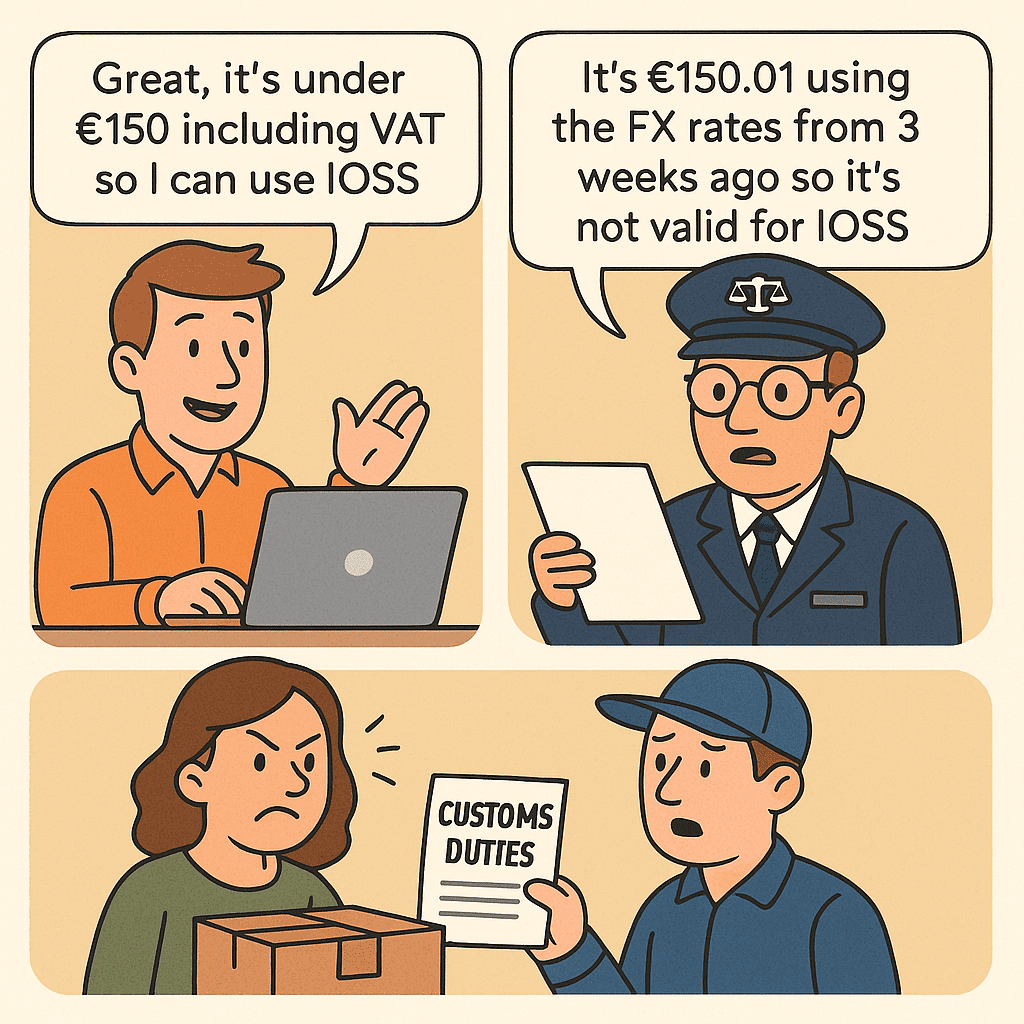
This creates an uncomfortable truth. A product that looks like €149 at your live checkout using up-to-the-minute FX rates might be €150.01 at the official EU rate.

So what?

  • The merchant thinks they sold something below the IOSS ceiling and can use streamlined IOSS shipping processes.
  • The customer thinks they bought something that qualifies for Duty-free import when in reality it attracts Customs Duties.

The Customs system disagrees with the Checkout. When that happens, the parcel stops. It gets treated as a non-IOSS import. Duties may apply. Handling charges may apply. The buyer gets a surprise at the door or they refuse the shipment. The merchant foots the bill for the return along with additional Carrier fees and an unplanned customer support ticket. Nobody wins.

And VAT makes the situation even more slippery. The €150 test must include the VAT that applies in the destination country – and in Euro at the official EU rate. The source-country tax, if any, must be removed from the product price. This means the threshold is based on a number the merchant does not normally calculate. If product prices include foreign taxes or when VAT rates differ per product category between countries, the threshold becomes even harder to evaluate.

So now we have three moving pieces: live FX at checkout, official FX at customs and destination VAT rates. Combine them incorrectly and the calculation can’t be counted on. It becomes a bit of a “pin the tail on the donkey” exercise unless you know your donkey back to front and inside out.

Merchants shouldn’t carry this cognitive load

Merchants often ask “Do I need to adjust my checkout prices to match the EU rate?” or “Do I need to explain these differences to customers?” or “Do I need a buffer margin to protect myself?” These questions all stem from a deeper issue. Merchants are trying to bridge two separate worlds. One world is consumer facing. It uses real time FX, price psychology and conversion optimisation. The other world is compliance based. It uses fixed FX tables, tariff schedules and rules that appear carved into marble.

Trying to align these worlds manually is a losing battle.

The trick is not to make your checkout behave like customs or your customs behave like checkout. The trick is to allow each to serve its own purpose and let a smarter system mediate between them. That’s where ePAL comes in.

ePAL sits between the shopper’s screen and the Customs officer’s desk

Here’s the secret: ePAL understands that checkout FX and customs FX do not need to match. It accepts that merchants want dynamic pricing for shoppers. It also accepts that Customs wants stability and predictability. Instead of forcing merchants to reconcile these values, ePAL automatically handles the conversion internally using the official monthly customs rate – solely for the purposes of IOSS validation.

In other words, ePAL checks the ‘official’ total value of the basket using official Euro rates, before the Customer sees the final price. If the official rate makes the basket ineligible for IOSS and/or eligible for Customs Duties, it silently calculates the Customs Duties and presents the whole result to the Consumer. Before the Customer ever sees a different price.

Confused? Sometimes we are too! 

How does this work? When the merchant calls ePAL in the checkout flow, ePAL takes the price as provided, removes any embedded source-country taxes, converts the net value into Euro using the official Customs rate, applies the destination VAT and performs the IOSS eligibility test properly.

The merchant doesn’t need to do a thing. ePAL returns a simple verdict:

  • “This consignment is eligible for IOSS”
  • “This consignment is not eligible for IOSS”
  • And all of the audit-ready data the merchant needs to prove it.

There is no uncertainty. No guesswork. No manual FX reconciliation. Merchants no longer have to worry that their live FX might misclassify orders. ePAL shields them from the complexity completely.

The customer sees whatever dynamic price the merchant shows. The Customs officer sees the correct valuation and the correct IOSS classification. Both are right in their own contexts because ePAL keeps the two worlds aligned without making them identical.

The quiet power of removing the problem entirely

This is one of those areas where the best solution is the one the merchant never sees. Merchants do not need a detailed briefing on customs FX policy or VAT valuation rules. They need something that just works.

With ePAL:

  • There is no need to change the shopper’s currency settings
  • There is no need to match checkout FX to Customs FX
  • There is no need to explain pricing discrepancies to customers
  • There is no need to build buffer margins around the €150 threshold
  • There is no need for manual checks or spreadsheets
  • There is no risk of misclassifying a shipment and causing a delivery failure

The merchant simply trusts ePAL to perform the correct valuation. If an item is above the €150 threshold at the Customs rate, ePAL routes it into the correct duty-and-VAT flow. If not, ePAL runs it through IOSS. No argument. No ambiguity.

This clarity is what ultimately matters. Cross-border eCommerce already contains enough grey areas without adding currency uncertainty into the mix.

Why all this matters more than merchants realise

The most expensive failures in cross-border commerce are not caused by bad products or bad couriers. They are caused by incorrect upstream data. A parcel that fails at the border costs more than a refund. It erodes trust. The customer blames the merchant. The merchant blames the carrier. The carrier blames the data provider. Everyone loses time and money.

A huge portion of those failures start with product classification errors, valuation errors and incorrect tax & duty logic. When merchants get the €150 test wrong they unintentionally sabotage the entire downstream chain.

ePAL fixes the root of the problem. Not by patching it. Not by estimating it. Not by approximating it. By implementing it correctly using the rules Customs actually use. And because the solution is API-driven and instant it slots invisibly into existing checkout flows.

The result is a checkout that can confidently say “No surprise costs at delivery” because the system beneath it has already done the hard work. Customers trust the price. Merchants trust the process. Carriers trust the data. Everyone gets what they expected.

Clarity is the real product

This is the common pattern in every eCommerce innovation that lasts. The technology isn’t the magic. The clarity is. Payments became simpler when gateways made fraud checks invisible. Delivery became predictable when tracking data became universal. Cross-border eCommerce becomes trustworthy when duties, taxes and FX logic stop being mysteries.

That is what ePAL exists to deliver. Not just calculations but confidence. Not just compliance but simplicity. The €150 threshold remains exactly as complicated as it ever was. The difference is that you no longer have to think about it.

For more, see www.ePALGlobal.com

Posted on Leave a comment

When “Delivery” is just the beginning of the Merchant’s problems

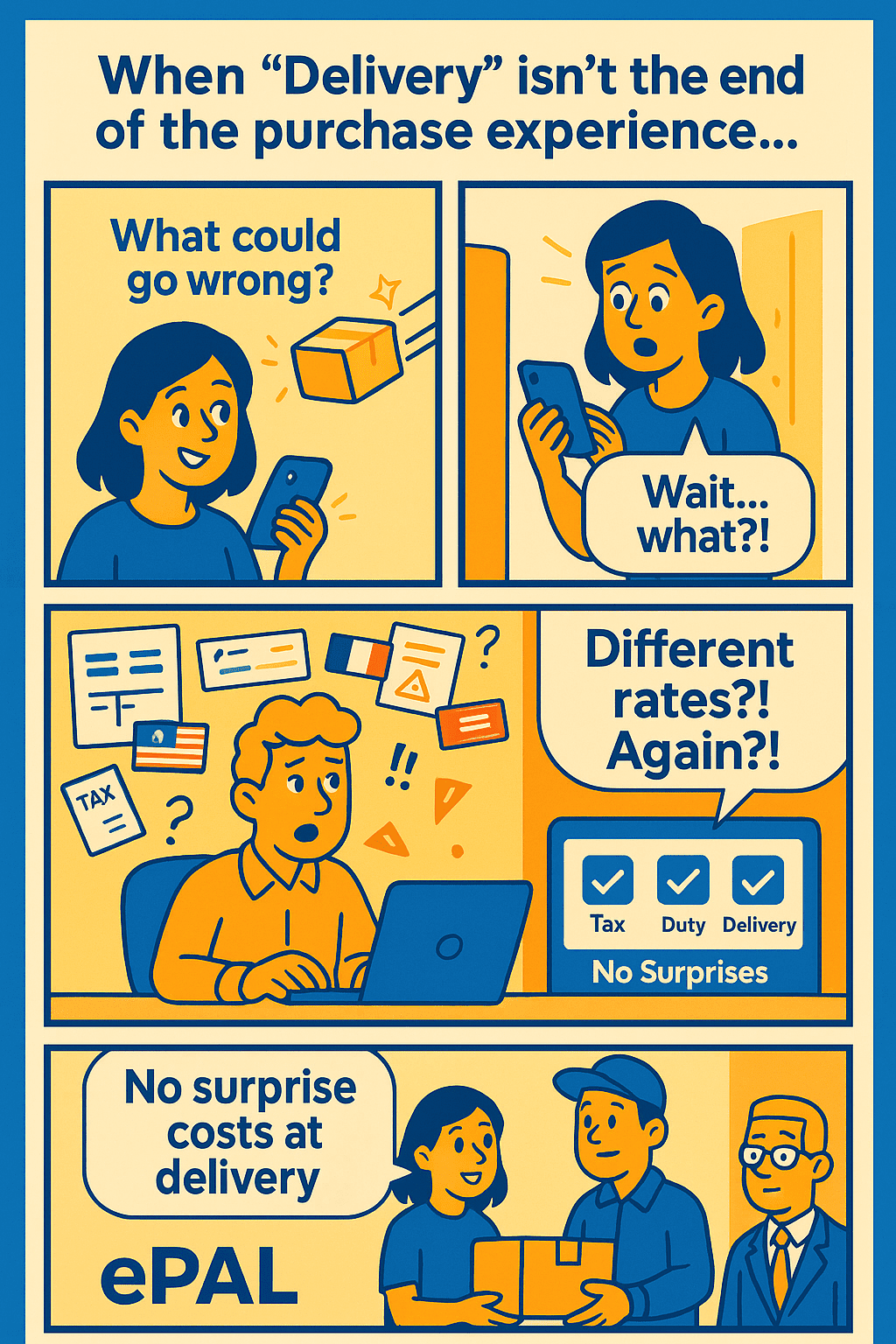
Cartoon-when-delivery-is-only-the-start-of-the-problem


Cross-border eCommerce has a trust problem.

Every day, somewhere in the world, a shopper clicks “Buy Now” convinced that the price on the screen is the price they’ll pay. A few days later, a courier appears at the door with a parcel in one hand and a surprise invoice in the other. That’s if the package even shows up. Maybe the only thing the buyer receives is an expected ransom demand: pay us more money or the parcel gets it

The buyer feels tricked- the seller feels blamed- and the carrier gets caught in the middle. It’s an awkward triangle built out of good intentions and bad visibility.

The hidden costs of “almost right”
Most checkouts for cross-border transactions are technically correct. They add VAT where needed, estimate shipping, maybe even flag import duties in small print. But “technically correct” is the kind of terminology Legal departments use… Marketing departments don’t want to tell their customer to ‘read the small print’. At least, not if they want the customer to return. 

Buyers remember the ‘surprise’ additional fees, charges and delays, not the footnote in the terms & conditions.

Sellers remember the headache and hassle of returns and refunds, not the regulations.

And the logistics provider remembers another failed delivery that wasn’t its fault.

The result?

  • Cart abandonment rates soar when duties aren’t clear & present until payment tim[Dd1] e.
  • Deliveries are delayed at import time because of missing Tax & Customs duty data.
  • Deliveries are rejected by the customer because they arrive with additional charges.
  • Consignments are returned at the Seller’s cost or destroyed by Customs if not returned.
  • Support teams drown in “Why was I charged extra?” messages.
  • Repeat sales drop, even when the product  and site were otherwise great.

In short: cross-border commerce works but it just doesn’t feel “trustworthy” to the buyer. And that feeling matters more than the Maths (or the small print).

The cross-border complexity that no-one signed up for
Behind every international order lives a web of hidden detail. There are product classification codes, tariff rates, duty thresholds, de-minimis limits, country-specific Tax rates, product-specific Duty rates, country-specific rules for calculating Tax on the Shipping costs, restricted goods & restricted buyer lists, rules for reclaiming Tax on refunded consignments… and more.

  • A pair of shoes might attract no duty in one country but 8% in another, depending on whether it’s leather, synthetic or a “sports article.” The Duty might only apply if they cost €150.01 or more or they’re shipped in a consignment with other products that together total €150.01 or more, regardless of what they originally cost.
  • Tax on goods in some countries is zero. For example, printed matter.  But unless the systems know what kind of printed matter the goods are (books, leaflets, maps, diaries & desk planners) the standard rate will be applied. This matters because it makes the product up to 27% more expensive. And then adds another unnecessary 27% to the tax on shipping.
  • A platinum wristwatch might attract standard Customs Duty, the same as any other product, but if the watch case is shipped alone (e.g. as a replacement part), it might attract Duty using a complicated calculation (sort of, but not quite correctly, summarised as “50c but only if 50c is between 2.7% and 4.6% of the price charged”). This changes the price the Customer has to pay.
  • Tax on shipping might be routinely charged at high ‘standard’ rates of tax (therefore pushing prices up) when, in fact, the Country-specific regulations might allow Shipping Tax to be reduced or even zero for many consignments and may even allow different rates of ‘tax on shipping’ for each item in the basket. This matters when tax refunds are made for returned goods.
  • A luxury item might sail through customs in Singapore yet get stopped in Spain because of packaging labelling rules. This matters because it delays the delivery and may incur handling charges for delays caused.
  • Products sent to any Country in the EU might sail through automated data checking but the same product might be stopped at the border in Germany because the advanced data shared by the Merchant via their Carrier is missing an 11th classification digit for each Product. This matters when the consignment arrives at the German border and is stopped for incomplete data.

And if you sell through your own website and via a marketplace, you may have two conflicting sets of tax obligations without realising it.

Merchants shouldn’t have to care about any of this. Customers certainly shouldn’t – and often don’t… they just buy elsewhere.

This is not territory most merchants want to navigate – but ignoring it isn’t an option. Compliance is no longer an afterthought – it’s the cost of doing business. Yet most sellers, even large ones, rely on incomplete plugin services, manual spreadsheets or carrier calculators that show only part of the picture.

Ask anyone who’s spent time in last-mile logistics and they’ll tell you: the delivery driver becomes the unwilling ambassador of every unclear transaction. They’re the ones who face the shopper’s frustration at the door, even though the surprise charge came from upstream systems they’ve never seen.

Each failed delivery costs time, money, and goodwill – not just for the seller, but for the entire ecosystem that touched that parcel. Multiply that by millions of cross-border orders a day, and you have a global leak of trust and efficiency.

 Enter ePAL: clarity at checkout
That’s the gap ePAL was built to close.

ePAL gives sellers, platforms, and logistics providers a shared, accurate view of the fully landed cost: the true end-to-end cost of getting a product from one country to another, including duties, taxes, and fees.

In simple terms: ePAL allows the buyer to see the total, compliant price before clicking ‘Buy’ and allows the Merchant to be sure neither they nor their customer will have any nasty surprises.

ePAL Global is a behind-the-checkout API or plugin that that identifies product classifications, tax & customs data, tariff schedules, and carrier networks. It calculates fully landed costs (aka Duty Delivery Paid or DDP) in real time in the checkout flow, based on product type, origin, destination and shipping method – all within milliseconds.

No more “estimated import fees.” No more awkward door-step negotiations or abandoned shipments. Just honest pricing, delivered instantly.

Transparency that pays for itself
When buyers see the total cost upfront, conversion rates improve.
When shipments are correctly declared, customs clearance accelerates.
When deliveries arrive without surprises, returned packages drop.

The economics are simple:
– Fewer failed deliveries → lower logistics costs & lower returns penalties.
– Fewer support tickets → happier operations teams.
– More repeat purchases → sustainable growth.

Trust becomes a measurable business outcome.

Built for everyone in the chain
For online sellers, integrate ePAL directly into your existing eCommerce platform or checkout. You don’t need to become a customs expert – the API does the heavy lifting.

For SaaS eCommerce platforms (e.g. WooCommerce), ePAL plugins allow Merchants to simply plug-and-play, integrating Tax & Duty calculations into existing stores in minutes.

For marketplaces, ePAL offers the invisible API orchestration layer to provide Duty Delivery Paid / Fully Landed Cost cross-border eCommerce capability to all your sellers..

For carriers and logistics providers, it reduces the failure points that damage reputation and margins. When every parcel leaves with the right declarations and fees already handled, the journey becomes predictable – and profitable.

From compliance burden to competitive edge
For years, “compliance” has been a word that caused eyes to glaze over but in cross-border eCommerce, compliance done well isn’t bureaucracy – it’s brand equity.

A merchant who can confidently say “No surprise costs at delivery” is instantly more trustworthy than one who can’t. The checkout becomes a promise, not a risk. And that confidence compounds across borders, currencies, and partnerships.

Clarity, confidence, compliance – in that order

ePAL isn’t just a calculator- it’s a communication tool. It translates regulatory complexity into consumer clarity. It helps sellers explain confidently what a parcel really costs, and it helps shoppers feel sure that what they see is what they’ll pay. That shift – from opaque to transparent – changes behaviour.

  • Buyers choose certainty.
  • Sellers gain loyalty.
  • Carriers gain reliability.
  • Everyone wins because everyone sees the same truth.

Why now?
The timing matters. Global eCommerce has outpaced the systems that govern it. Post-pandemic acceleration, tariff tantrums, regional tax reforms and the rise of micro-fulfilment networks have turned yesterday’s best practices into today’s liability.

Consumers now expect the same clarity buying from Seattle as they do from Sheffield, the same upfront certainty from long-distance sales as from local. The only way to deliver that consistency is to bring the invisible parts of cross border eCommerce – duties, taxes, compliance – into the equation, automatically.

That’s the future ePAL was built for: a world where cross-border eCommerce is as seamless, compliant, and transparent as domestic shopping.

Every great eCommerce innovation has simplified something people thought was inherently complex. Payment gateways demystified card processing. Digital wallets removed friction. Real-time tracking made shipping visible. Now it’s time to make fully landed cost quick, easy & transparent. This is why ePAL was created.

The bigger picture
What we’re really addressing isn’t just tax or shipping – it’s trust.

  • Trust that the price is honest.
  • Trust that the delivery will happen as promised.
  • Trust that global commerce can be simple, lawful, and fair for everyone involved.

In that sense, ePAL isn’t only a platform. It’s an enabler of better relationships across borders: between sellers and buyers, merchants and carriers, regulators and innovators. Because when clarity becomes normal, trust becomes easy and when trust is easy, global trade grows.

At ePAL, we believe global shopping shouldn’t require fine print or apologies. The total cost should be clear before the click – not after the knock on the door.

That’s what we’re here to deliver.

In one line: ePAL makes cross-border eCommerce simple, safe & transparent for everyone.

For more, see www.ePALGlobal.com
Posted on

Imagine F1

Imagine a world where Elvis Presley, The Beatles, Green Day and Marilyn Monroe all drove for the Scuderia Ferrari F1 team… we did.


Imagine F1 is a test store used by ePAL Global to test ePAL settings, features and functionality for the ePAL Global WooCommerce plugin and to help eCommerce merchants understand the complexities (and oddities) of cross-border eCommerce.

Feel free to play around & explore the test store to get an understanding of the capabilities that ePAL offers eCommerce merchants, including:

  • AI-assisted Product Classification for accurate Tax & Duty calculation
  • Tax & Customs Duty calculation in the basket & checkout so your customers know exactly what they’ll pay
  • IOSS validation for streamlined Customs clearance
  • Detailed ‘tax on shipping’ calculations to minimise the tax your customers pay, especially for ‘reduced rate’ goods
  • Tax ID validation and VAT-reduction calculation to allow Merchants offer B2C and tax-free B2B sales from the same shop, without managing separate B2C products & prices
  • Global shipping options & generation of correct Customs documentation

And if you find yourself with more than answers, don’t fret… you’re not alone and ePAL Global can make all those questions go away.

One-click cross-border eCommerce compliance.

For more, see www.ePALGlobal.com