
Ask any merchant what’s stopping them from selling more into the EU, and you’ll rarely hear “lack of customers.” Europe’s 450 million consumers are eager buyers. They love variety, quality and cross-border discovery. The real problem isn’t the demand — it’s the detail.
Behind every potential sale lies a tangle of regulations, declarations, tariffs, taxes, and thresholds that change from one border to the next. A product that clears customs smoothly in France might stall for days in Spain. A shipment that’s tax-free in Belgium might suddenly incur a 12% charge in Germany, for reasons that seem to live somewhere deep in the EU TARIC database.
For most merchants, this isn’t the business they signed up for. They didn’t build a brand to become experts in HS codes, IOSS eligibility, or excise duty on composite goods. Yet those details now define whether a cross-border order arrives on time, at the right cost, or even at all.
The invisible friction that kills growth
Every international sale begins with good intentions and ends too often with confusion. A shopper clicks Buy Now, confident that the price shown is the price they’ll pay. A week later, they get an unexpected invoice, a customs delay or – worse – a notice from a courier demanding extra duties before delivery.
The merchant loses credibility. The buyer loses trust. And the sale that should have been a milestone becomes a cautionary tale.
This isn’t an edge case. Across global eCommerce, cart abandonment rates rise sharply whenever duties or taxes aren’t clear at checkout. Even successful orders can become costly when shipments are delayed, held, or returned because of missing or inconsistent customs data.
Every unclear transaction is a potential delivery failure waiting to happen.
Complexity by design
EU import rules aren’t arbitrary: they’re just complicated.
To sell a single SKU across multiple EU countries, a merchant may need to:
- Identify the correct product classification (HS6 → HS10/11 in EU TARIC).
- Apply the right VAT rates (which vary by product and destination).
- Determine if the product qualifies for de minimis thresholds or special schemes like IOSS.
- Check if duties apply only above €150 or vary by composition.
- Decide whether tax applies to shipping and how to apportion it between line items.
- Confirm if the product requires safety marks, eco-labels, or packaging declarations.
- Ensure data transmission to customs systems in the correct format, in the correct currency.
Every bullet on this list carries a potential penalty for getting it wrong and a potential refund delay for getting it “almost right”. And there are many more than this list… Even for experienced sellers, “almost right” can be the costliest position of all.
The cost of caution
Many merchants respond to complexity by overcompensating. They pad prices, assume ‘standard rate VAT’ for all products, restrict shipping zones, or outsource fulfilment entirely to marketplaces or third-party logistics providers who promise to “handle compliance.”
The result? Margins shrink, customer experience fragments and the merchant becomes dependent on systems they don’t control and which may not even be talking to each other in the same language.
Others try to manage compliance in-house with spreadsheets, a hodge podge of plug-ins or carrier calculators that show part of the picture but not the whole story. They spend valuable hours matching codes, reconciling VAT rates, and double-checking if “tax on duties” really means what it sounds like (it often does).
The irony: the more cautious they become, the more expensive cross-border trade feels and the less competitive they appear to their customers.
Regulation as opportunity
But there’s another way to see it.
Regulatory complexity is, in essence, a trust barrier. Remove it (or even just make it predictable) and you gain something your competitors don’t: clarity.
- A buyer who knows the full cost at checkout is a buyer who converts.
- A parcel that clears customs the first time is a parcel that earns a repeat customer.
- A parcel delayed with additional charges might lead to a lost customer, not just a returned / lost sale.
- A business that can show authorities and partners that every shipment is compliant is a business ready to scale.
Transparency isn’t just a legal advantage – it’s a competitive advantage. One of the most powerful value statements a cross-border brand can make is “No surprise costs at delivery”
What “fully landed” really means
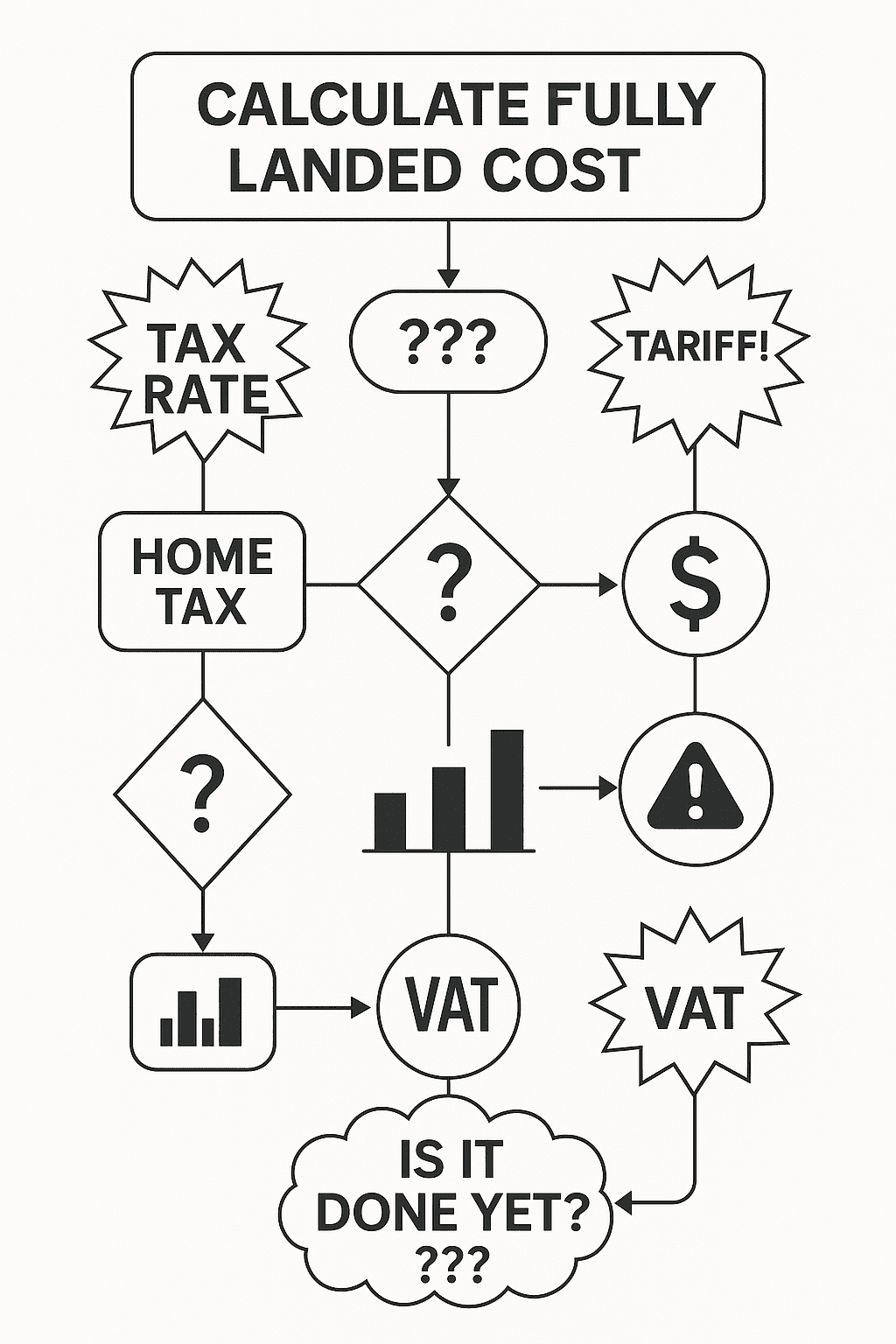
Behind the scenes, calculating a fully landed cost (also known as Delivery Duty Paid) is a precise science and a regulatory minefield. Fully landed cost is not just about “adding duties.” It’s about understanding how each layer interacts:
- Tax on product.
- Tax on shipping, at variable rates depending on basket.
- Customs duty based on composition and origin.
- Excise duty on specific categories.
- Even tax on the duties themselves — yes, that’s a thing.
Or, to put it another way, fully landed cost is… what ePAL does.
For more, see www.ePALGlobal.com