If you’re selling from outside the EU or expanding your reach within it, you’ve probably already discovered that “going cross-border” means more than just adding a few shipping zones to your checkout. It means mastering a patchwork of tax regimes, customs codes, trade thresholds, product classifications, safety standards, and the invisible monster: compliance.
The EU is one of the most lucrative online markets in the world but it’s also one of the most heavily regulated. For many merchants, that combination feels like standing at the gates of opportunity holding a suitcase full of paperwork and facing off against a battalion of bureaucrats.
The invisible barrier to growth
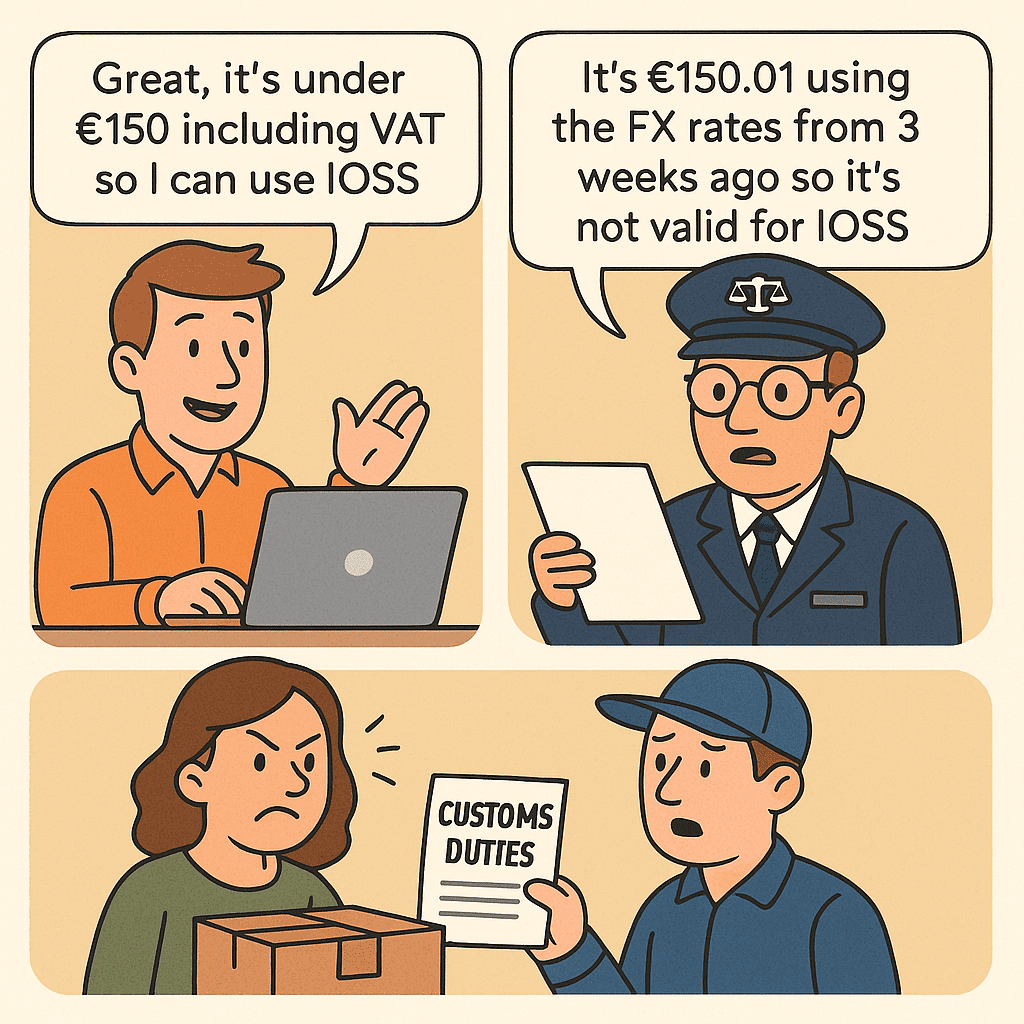
Here’s the irony: the same rules designed to make European trade fair and predictable can make it feel unpredictable to the merchants trying to comply. A single SKU can trigger five different tax and duty outcomes depending on its composition, packaging, and declared purpose. A €149 basket might pass smoothly through IOSS, while a €151 basket of the same goods triggers full customs duties, additional VAT and handling charges that turn profit margins into rounding errors.
Behind each transaction lies a maze of logic:
- HS codes that decide what a product is for regulatory purposes. And you might be amazed by the result.
- Tariff & Duty schedules that decide how much duty to charge and whether it’s based on weight, value, or category.
- Country-specific tax rules that might apply standard, reduced, or zero rates (sometimes all three within the same basket).
- Shipping tax apportionment that requires tax on delivery to be recalculated line-by-line depending on product type.
- Customs thresholds that change at €150, or sometimes don’t, depending on how “intrinsic value” is defined.
Multiply this across 27 EU member states and thousands of products and it’s easy to see why merchants hesitate. The complexity isn’t theoretical – it directly affects pricing, profit and customer experience.
The false economy of “just get it through”
Most small and mid-sized sellers take a pragmatic shortcut: estimate, approximate, and hope for the best. Maybe the plugin you use adds VAT automatically and maybe it’s at the “Standard Rate” (which means you’ll never undercharge VAT… but also means you might often overcharge and that makes your prices uncompetitive).
It works… until it doesn’t. Your “close enough” becomes expensive the moment a package hits customs with missing data or incorrect tax, duty or classification. Then comes the chain reaction:
- Parcels delayed (even if they’re eventually release with no additional costs)
- Or maybe simply refused by your Customer if there are additional charges.
- Angry customers who thought they’d already paid in full.
- Unexpected invoices for duties or taxes you didn’t collect from your Customer.
- Refunds that no longer match your original tax declarations.
- Support tickets and return costs that quietly eat your margin.
Compliance mistakes don’t scale: they compound.
And the more successful you become, the more they cost.
The paradox of compliance
The smartest merchants already know that compliance isn’t a checkbox; it’s a commercial function. Done properly, it builds trust, protects margins, and turns cross-border operations from guesswork into growth.
Because when you understand the real landed cost of your goods, you can do more than just stay legal. You can price confidently, advertise truthfully, and deliver predictably. And you can often find that your goods are cheaper than your competitors’ simply because they’re complaint.
That clarity isn’t just good governance. It’s good marketing. Think of it like this:
- Transparency is the new loyalty program.
Shoppers who know exactly what they’ll pay are far more likely to complete checkout and to come back. Conversely, if your Customer gets a shock at delivery, you may never even hear about it – or from them – again. - Speed is the new discount.
Consignments with correct data clear customs faster. That means earlier deliveries, fewer exceptions and lower carrier penalties. - Predictability is the new growth lever.
When your costs are stable, your pricing and promotions can be too. You’re no longer buffering your margins to cover uncertainty.
In short: what looks like a regulatory burden is, in fact, a strategic advantage if you can make it predictable.
Predictability: the currency of trust
To achieve that predictability, you need precision. And precision in the EU means understanding how taxes and duties interact in ways that aren’t obvious to the naked spreadsheet.
For instance:
- In Germany, VAT on shipping must be proportionally distributed across each product in a basket, based on its tax rate.
- In France, shipping might default to the highest VAT rate in the basket.
- In Ireland, a book shipped with a toy can shift the whole consignment’s tax treatment.
Those differences sound small until you scale up — then they’re the difference between a 22% margin and a 9% one.
Most systems don’t catch this level of nuance. They aren’t built to. They handle single products, not mixed consignments; simple duties, not layered taxes-on-taxes. But regulators are looking. Customs data checks are increasingly automated. A missing 11th digit in a product’s classification code can stop a shipment cold at the German border, even though it doesn’t affect the Tax or Duties.
Merchants don’t want to be customs experts. Shoppers don’t want to read footnotes. Yet somewhere in between, someone has to get the calculations right.
The moment compliance becomes competitive
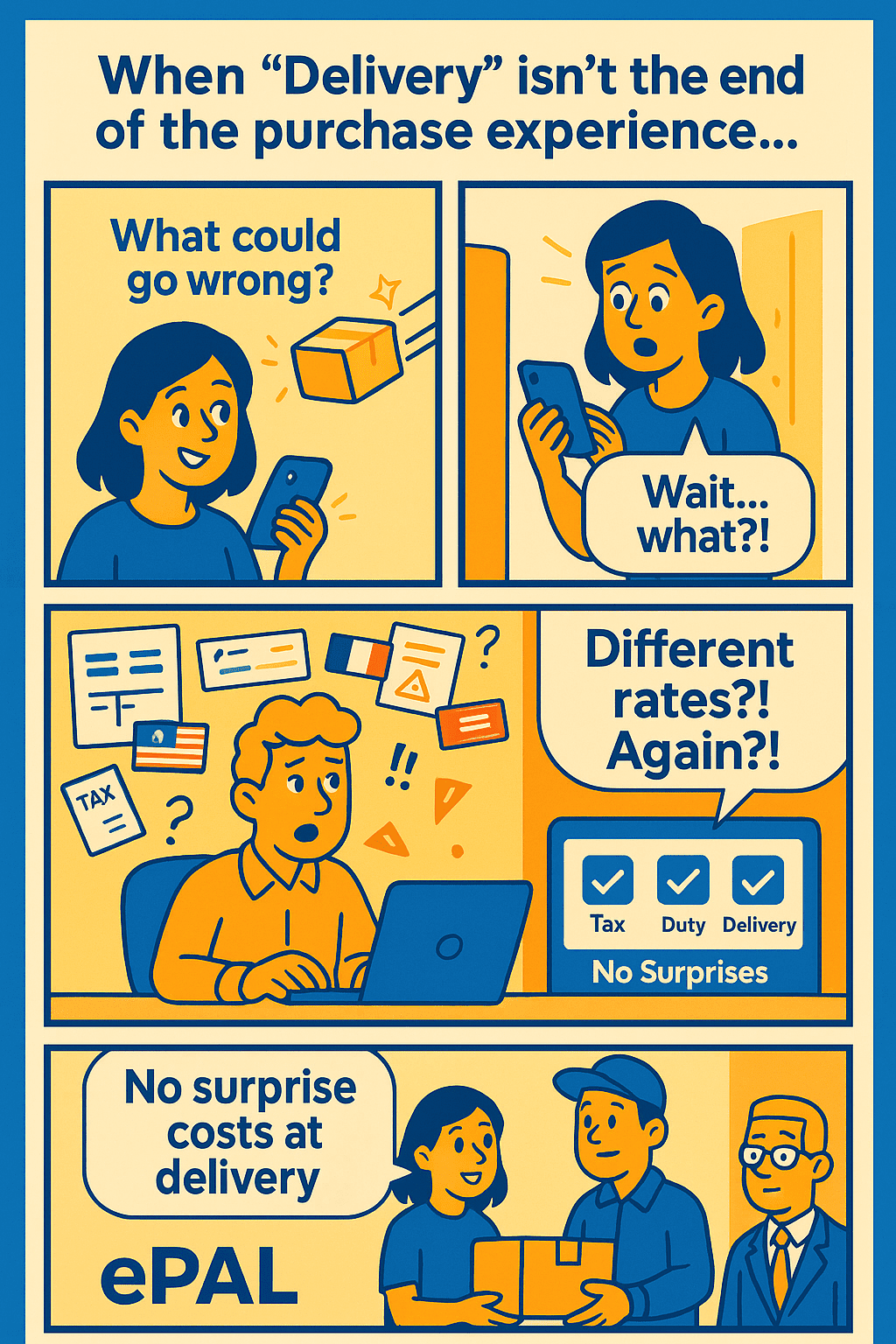
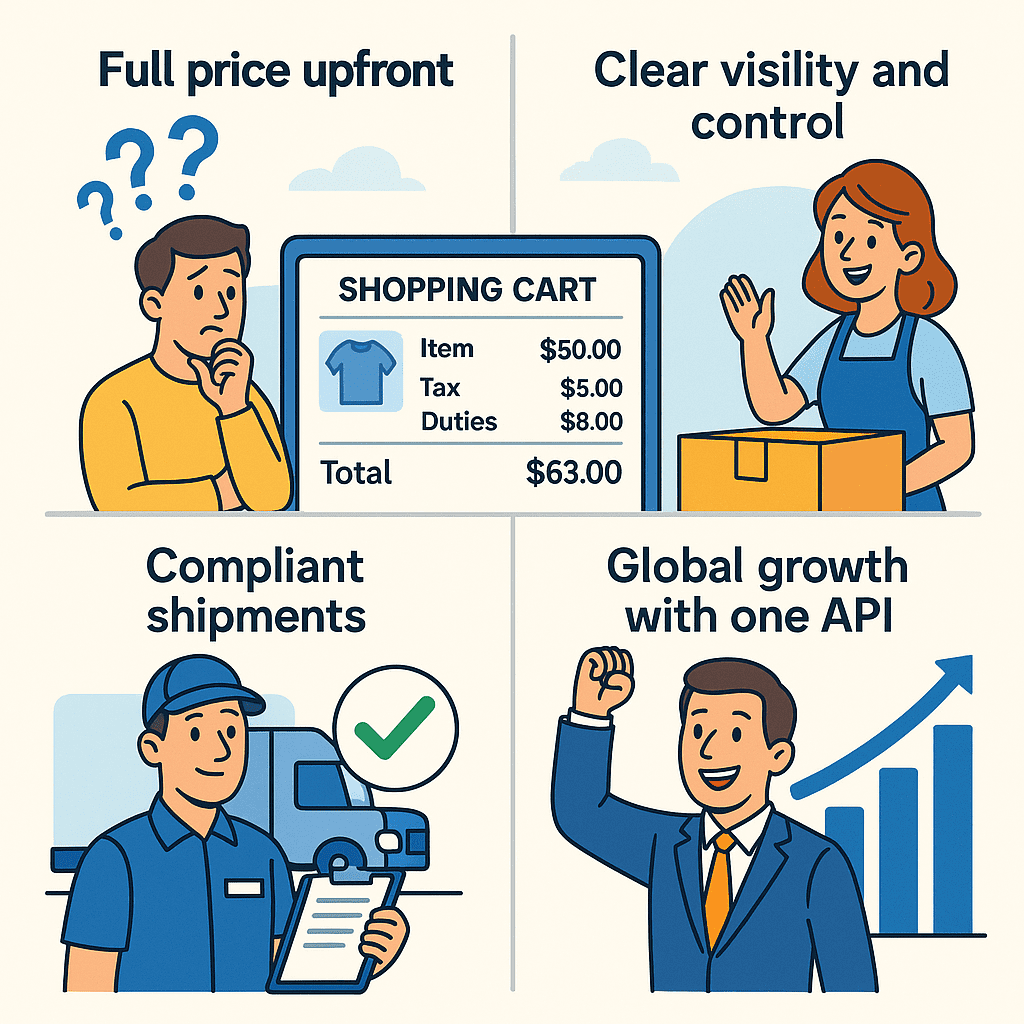
Here’s where the opportunity flips. Imagine being the seller who can say (with confidence) “No surprise costs at delivery.” Imagine showing the full, accurate, compliant price before checkout, broken out item-by-item, tax-by-duty. Imagine your customer never having to wonder whether “import fees may apply.” That’s not just compliance. That’s customer experience.
And it’s exactly where ePAL Global gives merchants their edge.
From compliance cost to commercial clarity
ePAL was built for the mess behind the maths – for multi-product consignments, tax-on-duty calculations, tariff rules and Shipping VAT apportionment that most systems skip. It maps product classifications, identifies the right HS10 or HS11 codes for each destination, retrieves the correct duty, tax, and excise rates, and then calculates the true fully landed cost… all in real time during Checkout.
It’s not about estimates; it’s about precision. So instead of guessing how customs will treat your products, you know. Instead of buffering your prices “just in case,” you can price with confidence. Instead of losing orders to cart abandonment, you can convert with transparency.
The result: the price your customer sees is the price they pay.
No extra invoices. No stranded parcels. No fine print.
What that means for your business
For merchants expanding into the EU, predictability changes everything:
- Pricing accuracy means fewer margin surprises.
- Declared compliance means faster customs clearance.
- Transparent checkout means higher trust and conversion.
- Reduced support overhead means more bandwidth for growth.
And for established exporters, it means being able to operate cross-border without building a compliance department or hiring a customs broker for every product category.
It’s compliance-as-a-service, in the truest sense, delivered through a single API or plugin that slots directly into your existing checkout.
The numbers that matter
With ePAL Global, compliance isn’t a cost sink – it’s a fixed, predictable value:
- 1.5% of cross-border baskets for eCommerce merchants.
- €999 per year for importers and exporters.
That’s it. No hidden duties, no sliding-scale brokerage, no post-delivery surprises.
When you can quantify your compliance cost, you can treat it like any other line of business: predictable, measurable, and optimisable.
The bigger picture
The future of cross-border eCommerce belongs to the merchants who treat compliance not as a defensive shield, but as an offensive strategy – a differentiator based on transparency and trust.
In an era where customers expect clarity, regulators demand accuracy and competitors are just one click away, the ability to promise “no surprises” isn’t just good ethics, it’s good business.
That’s the world ePAL Global was built for: a world where merchants can expand confidently, sell compliantly, and deliver seamlessly across every border, every basket, every time.
ePAL Global: turning the cost of compliance into your competitive advantage for eCommerce merchants, importers and exporters. No surprises. No uncertainty. Just clarity… delivered.
For more, see www.ePALGlobal.com